Wangiri One-Ring Callback Scam
How the scam works
Step 1 - The bait call. Your phone rings once or twice from an unfamiliar international number - typical origins include Tonga (+676), Tunisia (+216), Mali (+223), Burundi (+257), Côte d'Ivoire (+225), Albania (+355), Pakistan (+92), Guinea (+224), Sierra Leone (+232). The caller hangs up before you can answer. Sometimes the scammer uses autodialers to ring thousands of numbers per hour across an entire country's area code range.
Step 2 - The missed-call hook. You see the missed call and wonder who it was. A job interview? A relative abroad? A forgotten contact? Curiosity, worry, or habit prompts some people to call back.
Step 3 - The premium connection. When you return the call, you reach a premium-rate number that bills by the second. You might hear a recorded 'please hold', fake dial tone, long silence, or a confusing prompt menu designed to keep you on the line. Every second costs the caller - typically $3 to $20 per minute, sometimes higher. The scammer and the local carrier split the revenue.
Step 4 - The bill shock. Days or weeks later you receive a phone bill with a charge of $30, $200, sometimes over $1,000 for a single return call. By the time you notice, the money has already been split with the foreign carrier and is often non-recoverable.
Why certain country codes
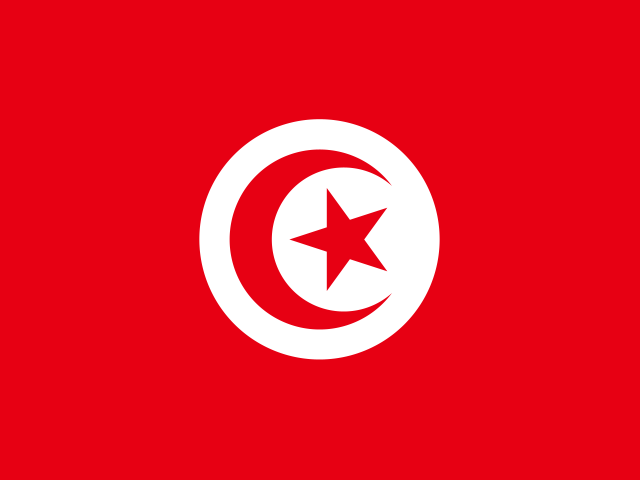
Wangiri scammers don't pick countries randomly. They target country codes that (a) have premium-rate agreements allowing revenue sharing with international carriers, (b) are unfamiliar enough that victims don't immediately recognize the flag, and (c) have weak or absent regulatory enforcement against premium-rate abuse. Small-population countries with high diaspora populations are favorites - Tonga and Tunisia in particular have been the sources of multi-year wangiri waves.
Some country codes deserve particular caution:
- +676 Tonga - the most-reported wangiri origin in US FTC complaints 2020-2024
- +216 Tunisia - heavy EU and UK targeting
- +355 Albania - targets Italian, German, and US diaspora
- +232 Sierra Leone, +224 Guinea, +223 Mali, +225 Côte d'Ivoire - West African cluster hitting Europe and North America
- +92 Pakistan specific numbers - blends with legitimate diaspora calls, hardest to filter
Variations
SMS wangiri. Instead of a ring, you receive a text: 'Call me back urgently - John' or 'Your package is held, call +XXX.' Same premium-rate callback trap.
Voicemail wangiri. The scammer leaves a short, unclear voicemail - 'I'm the one you spoke with yesterday, call me' - designed to trigger callback.
Silent call wangiri. Some campaigns use very long one-way rings that queue into voicemail with no message, hoping the victim calls back to identify who it was.
Why it still works in 2026
The scam persists because:
- Mobile carriers do not block outbound premium-rate calls by default. The call goes through, the bill appears later.
- International premium-rate regulation is fragmented - the country operating the number often has no incentive to shut it down (they earn revenue share).
- Caller ID spoofing is increasingly difficult to prevent end-to-end. STIR/SHAKEN protocols help domestically but don't cover international interchange fully.
- The scheme is low-cost per attempt - autodialers can ring 10,000 numbers per hour at near-zero marginal cost to the operator.
Financial exposure
Typical wangiri callback charges range from $10 to $300 for a single return call. Determined scammers use techniques that keep victims on the line - fake menus, 'transferring your call', hold music - pushing single-call bills into the thousands. Because the charges appear on your carrier bill under international premium-rate codes, most carriers will not dispute or refund them unless you can demonstrate fraud and the carrier's goodwill policy applies. Unlike most cybercrimes, wangiri is not a distinct category in the FBI IC3 annual report - it is tracked by national telecom regulators (FCC, Ofcom, ARCEP, BNetzA) through consumer complaints about unauthorized international premium-rate charges.
Sources
- FCC Consumer Guide: One-Ring Wireless Phone Scams
- FTC Consumer Sentinel Network Data Book 2023 - Phone-call contact method $850M, 297,765 reports (page 12)
- Ofcom: Tackling scam calls and texts
- FTC Consumer Alert: Wangiri scams
Warning signs
- Single-ring missed call from an unfamiliar international country code
- Country code does not correspond to anyone you know (no relatives, no clients, no ordered delivery)
- Missed call arrives in the middle of the night your local time
- Multiple neighbors or colleagues also received calls from the same or similar numbers in a short window
- Text message from international number urging urgent callback without context
- Voicemail that's deliberately ambiguous or inaudible, urging you to call back to identify the person
- Number's country code maps to a high-risk wangiri origin (Tonga +676, Tunisia +216, Mali +223, Albania +355, etc.)
- Carrier bill shows a return call that connected for an unusually long time despite being 'nothing happened'
What to do if you've been targeted
- Do not call back. Never return a call to an unfamiliar international number.
- If you must verify the call, search the number on DialCode, Google, or your local scam database before dialing.
- Block the number at the carrier level or via your phone's built-in blocking feature.
- Ask your carrier to enable 'international premium-rate call blocking' - most offer this free on request.
- If you already called back, end the call immediately and check your account for charges.
- Dispute any premium-rate charge on your carrier bill within 60 days citing wangiri fraud.
- Report the originating number to your carrier's fraud team so it can be added to network-level block lists.
- File a complaint with the FTC (reportfraud.ftc.gov), FCC (fcc.gov/complaints), or your country's telecom regulator.
- Warn family and colleagues - wangiri waves hit contact networks in clusters.
How to report
In the US, report to the FTC (reportfraud.ftc.gov) and FCC (fcc.gov/complaints) - the FCC tracks premium-rate international number abuse and can request blocks at the interchange level. In the UK, file with Action Fraud (actionfraud.police.uk) and Ofcom. In the EU, use your national telecom regulator (e.g., BNetzA in Germany, ARCEP in France). Always report the full dialed number to your carrier so it can be added to deny lists; carriers aggregate reports and collectively block abusive prefixes.
Statistics
Wangiri is not a discrete category in the FBI IC3 annual report or the FTC Consumer Sentinel Data Book - it is tracked by national telecom regulators. For context on phone-initiated fraud broadly: FTC 2023 recorded $850 million in losses across 297,765 fraud reports where phone was the contact method, with a $1,480 median loss (second-highest median of any contact method after social media). The FCC publishes ongoing advisories naming Tonga (+676), Sierra Leone (+232), Guinea (+224), and Mali (+223) as common origins for US-targeted one-ring scams; Ofcom reports Tunisia (+216) and Albania (+355) as dominant origins for UK-targeted waves. Typical per-incident wangiri loss is $10 to $300 per completed callback, with outlier cases exceeding $1,000. Source: FTC Consumer Sentinel Network Data Book 2023, page 12.
Country codes most associated with this scam
These country codes appear most frequently in wangiri one-ring callback scam reports. Scammers rotate origins constantly - treat this as historical context, not a whitelist.